Legible by Grazing: Exterior Steel Lighting That Meets Dark-Sky Expectations
The misunderstanding at the heart of dark-sky compliance
Exterior lighting for steel features is frequently compromised at the drawing stage by an assumption that planning authorities want less light. What most UK authorities actually want is light that is accounted for: a stated purpose, a defined target, a measured cut-off and a control regime that does not leave the installation running unattended until dawn.
That distinction matters commercially. A client who has paid for a Corten screen or a galvanised balustrade expects to see it after dark. The specification task is not to reduce the wattage until the metal disappears, but to place the beam so precisely that the surface reads while the sky above it remains unlit. Grazing light, held to the plane at a shallow angle, achieves more for metal than a broad wash ever will, and it is also the approach most likely to survive an officer's scrutiny.
Begin with the environmental zone, not the fitting
The Institute of Lighting Professionals' guidance on obtrusive light, generally read alongside BS 5489-1, sets environmental zones from E0 to E4. A remote national park or a rural dark-sky reserve sits at the lower end; a town centre sits at E4. Upward light ratio, luminous intensity in the direction of the sky and illuminance at neighbouring curtilage are all capped accordingly, and the lower zones are unforgiving.
Establish the zone before any luminaire is selected. A rural Herefordshire conversion and a Sheffield city-centre courtyard will not accept the same solution, even if the Corten is identical. Where the site falls within a conservation area, an Area of Outstanding Natural Beauty or one of the national parks that hold dark-sky status — Exmoor, the Yorkshire Dales, Eryri and the Bannau Brycheiniog among them — expect the zone to govern the design and expect to evidence it.
Colour temperature and the appearance of metal
There is a happy coincidence here. The lower colour temperatures that planners prefer, typically 2200K to 2700K, are also those that flatter weathering steel. A 2700K source deepens the oxide tones of Corten and holds the difference between the stable outer layer and the mill scale beneath it. Move to 4000K and the material flattens into a uniform orange-brown; the patina stops reading as a patina and starts reading as a colour.
On galvanised and zinc-coated surfaces the relationship reverses. Cooler light tends to emphasise the crystalline spangle, which may be desirable on a feature panel and undesirable on a large plain elevation. On brushed stainless, low colour temperature reduces the blue cast that can make specular highlights look clinical. Whichever direction is chosen, hold it consistently across the scheme, specify the colour consistency tolerance, and record the choice in the lighting schedule as a fixed parameter rather than a substitution option.
Ecology adds a further constraint. Where a scheme abuts a watercourse, a hedgerow or mature treeline, bat guidance jointly published by the Bat Conservation Trust and the ILP favours warm, low-output sources with negligible ultraviolet content, together with strict control of spill. Amber sources in the region of 590 nanometres are sometimes specified beside sensitive corridors, though their colour rendering limitations should be acknowledged rather than discovered on site.
Aim the light, then shield what is left
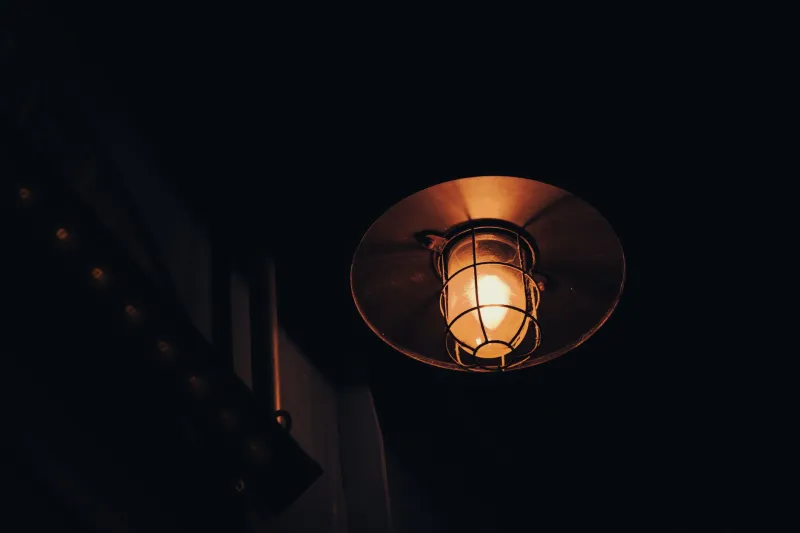
A shield is not an admission of a badly chosen fitting; it is the detail that makes the fitting acceptable. Specify luminaires with a recessed LED position and a cowl or louvre arrangement that pushes the beam below the horizontal. On a retaining wall or a plinth, mount the fitting low and outboard, tilted back towards the surface, so the light strikes the metal at perhaps five to fifteen degrees. The beam should terminate at or just below the top edge of the steelwork. If light is escaping above that line, the aim is wrong and no accessory will fully correct it.
Specular surfaces demand extra care. A polished or highly reflective metal will throw a beam sideways into a neighbour's window with very little provocation. Where polished finishes are unavoidable, choose asymmetric optics, add baffles, and keep the source out of the reflected sightline from habitable windows. Diffuse surfaces — acid-etched, bead-blasted, powder-coated — are far more forgiving and are usually the better specification where a boundary is tight.
Mounting height, glare and the question of who is looking
Mounting height is often chosen for convenience of fixing rather than for optics. Above roughly 2.5 metres, a small aperture fitting starts to become a visible point source from a distance, and glare complaints frequently follow. Below that height, the fitting disappears against the surface and the wall becomes the light.
Where the steelwork itself provides the mounting, use it deliberately. A deep beam flange, a column web or a fabricated channel can conceal cable routes and house a linear grazer with almost no visible hardware. Fixings should be stainless, A2 or better, and the cable entry should always be from below, since water tracking along an upward entry is the most common cause of premature failure on exposed metal installations.
Control is part of the specification
A dark-sky-compliant scheme is one that is off for most of the night. Astronomical time clocks, rather than photoelectric cells alone, prevent the dusk-to-dawn operation that so often irks neighbours in summer. A dimming profile that drops scene levels substantially after a curfew — 23:00 or midnight is a common planning condition in rural districts — is straightforward with DALI drivers and should be written into the commissioning schedule.
Presence detection has its place on circulation routes but should be used with restraint on feature lighting; repeated triggering of a warm-white grazer across a Corten wall becomes a nuisance in its own right. Where detection is required, specify a long hold time, a low background level and a gradual fade rather than an abrupt switch.
Evidence the design
Submit a lighting impact statement with the application: a layout plan, isolux contours demonstrating the extent of useful light, the calculated upward light ratio, and a control narrative. Where the scheme sits in a sensitive zone, a short post-installation verification — measured illuminance at the boundary and a night-time photograph of the elevation — is inexpensive and forestalls later complaint.
Light that is aimed is light that is defensible. Steel, more than most materials, rewards the approach: grazed rather than flooded, warm rather than cool, low rather than high, and switched off when nobody is looking.