After the Sun Sets: Lighting Steel and Corten Elevations with Precision
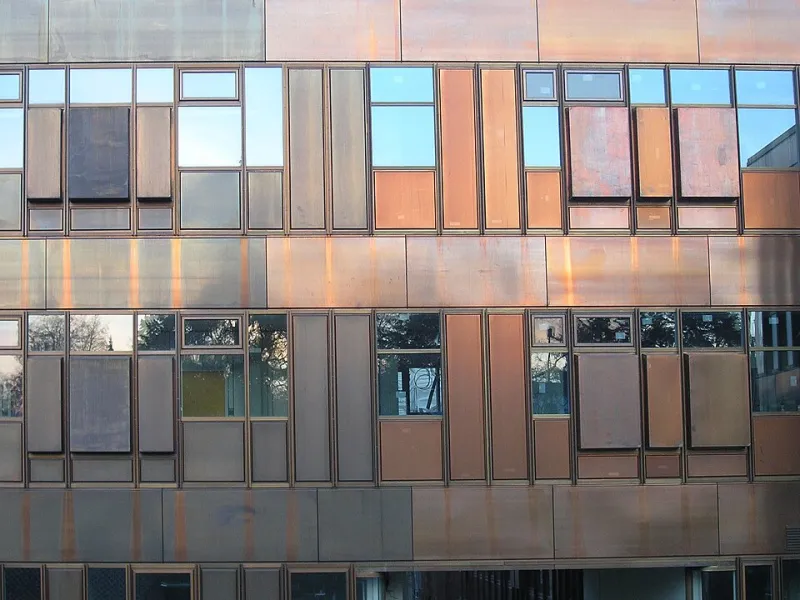
Photo: Kanakari, CC BY-SA 3.0, via Wikimedia Commons
Exterior steel and corten cladding have become familiar on UK extensions, garden rooms and commercial frontages. They are chosen for colour, texture and precision, yet their lighting is often added at the end of the project, when the cable routes are fixed and the planting is in. The result is a facade that works by day and becomes a flat, over-lit surface at night.
A more rigorous approach begins with the surface. Steel cladding is not a single material condition: ribbed profiles, flat panels and perforated sheets each need a different optical treatment. The lighting should reveal those differences rather than wash them out.
Lighting is part of the facade
For a design-led homeowner, exterior lighting is often understood as security or decoration. For a trade specifier, it is a technical layer that affects appearance, maintenance and compliance. Both perspectives meet in one principle: light the architecture, not the air. A well-resolved scheme uses a small number of controlled fittings, aimed with purpose, rather than a broad flood of illumination.
Reading the surface: ribbed, flat and perforated
Ribbed steel benefits from grazing light. A narrow-beam fitting of 10 to 20 degrees, set close to the wall and aimed along the ribs, creates shadow lines that give the profile depth. An offset of 150 to 300mm from the face is often enough, depending on the rib depth and the degree of contrast required. The aim is a consistent scallop or a continuous shadow, not a series of hot spots.
Flat panels need a different approach. A broad wash of 30 to 60 degrees can give an even field, but it can also exaggerate panel joints and surface irregularities. A deliberate scallop, where the light is allowed to fall in a controlled rhythm, is often more forgiving. On dark or matt finishes, lower output and a warmer colour temperature will preserve the material's character.
Perforated steel is the most graphic option. Light passing through the perforations can create a pattern on the surface behind, but the effect depends on the source being diffused and the cavity being clean. A visible lamp behind a perforated sheet will read as a row of bright points. A diffused source, set back from the sheet, gives a softer glow and a more legible pattern.
Corten has a warm, variegated patina that changes with weathering. Cool white light makes it look grey and flat; a warm source in the 2700K to 3000K range will bring out the orange and brown tones. A high CRI, ideally with a reasonable R9 value, helps render the red content of the material.
Colour temperature and rendering
For residential elevations, 2700K to 3000K is usually appropriate. It sits comfortably with planting, brick and timber, and it avoids the blue-rich appearance that can make a house look commercial. For commercial frontages, 3000K to 4000K may be justified, but the higher end should be used with care. A CRI of 80 or above is a sensible minimum; 90 or above is preferable where corten or coloured cladding is a feature. Dimming is not optional. A facade that is fixed at full output will date quickly and annoy neighbours.
IP ratings, fixings and corrosion
Exterior fittings should be at least IP65, with IP66 or IP67 preferred for exposed positions. The IK rating matters where fittings are close to ground level or within reach. In coastal locations, 316 stainless steel fixings are the prudent choice, and contact between dissimilar metals should be avoided. Isolation washers and appropriate cable glands help prevent galvanic corrosion. Drivers should be located in an accessible, IP-rated enclosure, not buried behind cladding. Cable entries should allow for drainage and movement, and every fixing should be specified for the substrate, not simply for the luminaire.
Beam control and dark-sky-friendly placement
A facade scheme should not spill light into the sky or into neighbouring windows. Full cut-off optics, shields and careful aiming are basic requirements. Uplights should be aimed below the horizontal where possible, and the number of fittings should be kept to what the architecture needs. Timers, photocells and presence detection can reduce operating hours without making the entrance feel unwelcoming. The Institution of Lighting Professionals guidance on obtrusive light is a useful reference for UK projects, particularly where the elevation is close to a boundary.
Commissioning the night elevation
A daylight mock-up is of limited value. The scheme should be commissioned after dark, with the actual finishes in place. Adjust aim, output and scenes then, not on the basis of a catalogue image. The best exterior lighting for steel and corten is restrained: it gives the material a presence after sunset without turning the garden into a floodlit car park. When the surface is read clearly and the source is controlled, the architecture continues to work long after the sun has gone.