Polished Surfaces, Measured Light: Specifying Above Steel Kitchen Islands
Photo: Ermell, CC BY-SA 4.0, via Wikimedia Commons
A stainless-steel kitchen island is rarely just a worktop. In contemporary UK kitchens it is a working surface, a social anchor and, increasingly, a deliberate piece of metalwork. It is also a lighting brief in disguise. The same pendant arrangement that reads as calm and considered above quartz can become a row of bright, repeating highlights on a brushed-steel surface. The task is not to avoid steel but to specify light that acknowledges how the material behaves.
Why a steel worktop changes the calculation
Steel worktops fall into two broad families: mirror-polished surfaces, which behave almost like a looking glass, and brushed or satin finishes, which scatter light in a softer but still directional way. Both create veiling reflections. In practice, the eye sees not only the luminaire but also its reflected image in the worktop, and the contrast between the two can be more distracting than the fitting itself.
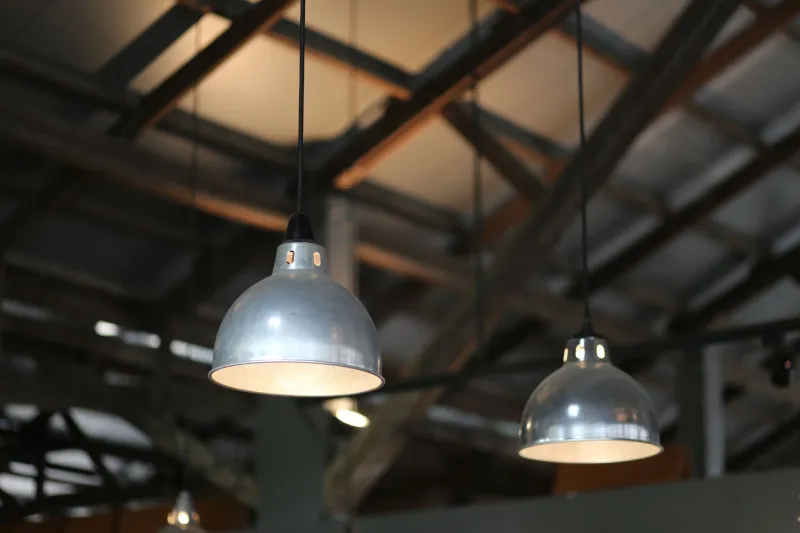
The effect is strongest when small, high-luminance sources are used close to the surface. A cluster of exposed lamps above a polished island will produce a second, inverted cluster in the steel. Brushed metal softens the outline but does not remove it. Specification therefore needs to consider luminance, diffusion and geometry together, rather than treating the fitting as a decorative object chosen after the worktop.
Three families of fitting, assessed
Linear suspensions
A continuous linear suspension is often the most forgiving choice above a steel island. A diffused opal extrusion spreads the source across a longer line, lowering luminance and reducing the point-by-point sparkle that smaller pendants create. Slim steel profiles, typically 40mm to 60mm in section, also echo the material of the island without competing with it.
Linear runs work best when they follow the island rather than cross it. On a long island, a single run centred over the worktop gives an even wash; on wider islands, two parallel runs may be preferable to one central line. The diffuser should be opaque enough to hide individual LED chips but neutral enough not to tint the steel.
Low-glare downlights
Recessed downlights suit schemes where the ceiling should remain quiet, or where a low ceiling makes pendants awkward. The specification matters: a deep baffle, a honeycomb louvre or a recessed lens will control glare far better than a shallow fixed downlight. A UGR of below 19 is a reasonable target for a domestic kitchen, and lower figures are preferable where the worktop is highly reflective.
Downlights do, however, produce scallops of light on vertical surfaces and can create bright pools on the steel. Spacing and beam angle need to be set out carefully, and asymmetric or wall-washing versions may be better for the perimeter of the island than for the worktop itself. A combination of ambient downlights and a separate task layer often reads more calmly than downlights alone.
Slim track systems
A slim track, typically 13mm to 16mm in section, offers flexibility without the visual repetition of multiple pendants. Adjustable heads can be aimed towards task areas, and the track itself can be finished in powder-coated steel or a brushed metal to match the island. The risk is hotspotting: a narrow beam aimed directly at a brushed surface will produce a visible pool of light and a corresponding reflection.
Track works best when the heads are fitted with snoots or anti-glare accessories, and when the aiming is set after the kitchen is complete rather than at first fix. It is a useful middle path for homeowners who want to change the emphasis between task and ambient lighting over time.
Height, spacing and the reflected image
Pendant mounting height is the single most consequential decision above a steel island. As a working rule, the lowest part of the fitting should sit 750mm to 850mm above the worktop. On a standard 2.4m ceiling, that usually means a suspension drop of roughly 1.0m to 1.2m, depending on the fitting depth. Higher than 850mm and the task light becomes less effective; lower and the reflected source becomes more prominent in the steel.
Spacing should follow the worktop rather than the room. For task lighting, centres of 600mm to 700mm are typical; for purely ambient or decorative runs, wider spacing can work. On islands deeper than about 1.2m, a single central line of pendants may leave the outer edges underlit, and two lines or a wider linear diffuser should be considered.
The final check is the reflected image. Before committing, stand at the island and look across the worktop at normal eye height. If the reflected source is brighter than the surrounding surface by a wide margin, the scheme will feel restless in use.
Beam angles, colour temperature and control
For task lighting, beam angles of 24° to 36° are usually appropriate; for ambient layers, 50° and above give a softer spread. Colour temperature should generally sit between 2700K and 3000K in a domestic kitchen. Cooler temperatures can make stainless steel look clinical and tend to increase the perceived intensity of reflections.
Colour rendering should be 90 CRI or better, particularly where food preparation is the main activity. Dimming is not optional: a circuit that dims smoothly to 5 per cent or lower allows the lighting to shift from task mode to evening mode without switching off the island entirely. Separate circuits for task and ambient light give the greatest control, and a simple scene-setting dimmer is often more useful than a complex control system.
Finish and material notes
Finish choices should reduce secondary reflections rather than add to them. High-gloss chrome directly above polished steel tends to double the visual noise; matte powder-coated steel, brushed nickel or bronze are usually calmer. Where a metal finish is chosen, PVD coatings offer good durability against cleaning and handling.
Diffusers matter as much as housings. Opal polycarbonate or frosted glass will obscure the source; clear glass will not. If exposed lamps are part of the design, they should be frosted or softly coated rather than clear, and they should be dimmable without flicker.
Commissioning in a lived kitchen
A steel island is best assessed at night, with the worktop empty and the room lighting set to its usual evening level. Check the scheme from seated eye height as well as standing height, and look for reflections in the steel rather than only at the fittings. Where contrast between the island and the surrounding room is strong, low-level plinth or cabinetry lighting can reduce the effect without adding glare.
Specified with these constraints in mind, steel becomes an asset rather than a complication. The aim is a worktop that reads as deliberate metalwork under a measured layer of light, not a surface that repeats every bright point above it.