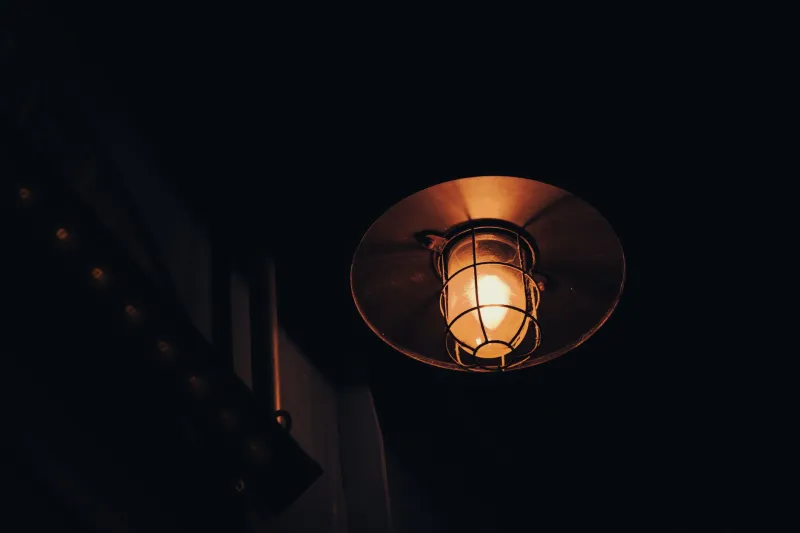
Shelter, Then Signal: Concealed Light at Steel Entrance Thresholds
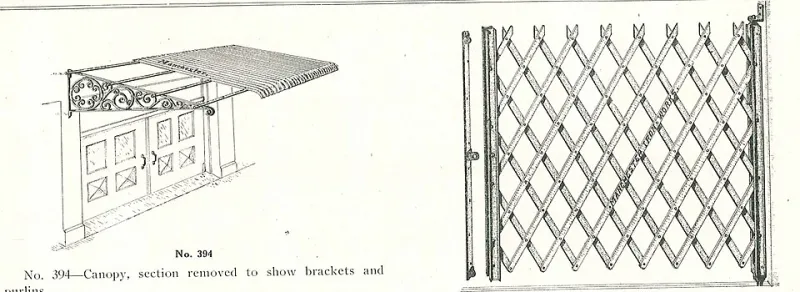
Photo: Internet Archive Book Images, No restrictions, via Wikimedia Commons
An entrance is rarely a single object. It is a sequence: the approach, the shelter of the canopy, the face of the door, the reveal, and the precise line where outside becomes inside. When that sequence is lit well, the visitor reads it without thinking about the fittings. When it is lit poorly, the canopy becomes a bracket for a lamp and the door reveal becomes a place where a security measure has been attached after the event. The difference lies less in the luminaire than in how the threshold is composed.
For UK homes and small commercial buildings, the steel entrance canopy is a useful test case. It is exposed to driving rain, sustained damp and low winter sun. It may be powder-coated, galvanised, or specified in a weathered steel. It often has a thin construction, leaving little room for concealed services. And it sits directly at eye level, where glare is noticed immediately. A successful scheme treats light as part of the canopy detail rather than as an addition to it.
Begin with the threshold, not the fitting
The first design move is to decide what the light is doing at each point in the sequence. A low-level wash across the approach may be enough to show the edge of a step. A concealed linear source under the canopy can reveal its soffit and provide a soft field of light around the door. A shallow recess in the door reveal can pick out the frame and handle without turning the entrance into a pool of over-brightness. Each layer has a different job and should have a different intensity.
This is where many domestic entrances go wrong. A single bulkhead or downlight is asked to provide safety, welcome, door identification and architectural expression at once. It usually achieves the first and fails the rest. A more disciplined approach separates wayfinding from arrival. The canopy light gives shelter a visible edge; the reveal light gives the door a legible outline; a small, well-shielded source at the threshold gives the step or mat area definition. The result is quieter and more precise.
Weather sealing and the wet side of the line
In the UK, the exposed soffit of a steel canopy should be treated as an exterior location, even when it appears protected. Wind-driven rain can reach upward and sideways. Moisture can sit in shallow sections. Cable entries can become paths for water if they are not planned. The IP rating is therefore only the starting point. A fitting marked IP65 may be appropriate for an exposed soffit, while a source set back into a sheltered reveal might be specified at a lower rating, provided the manufacturer’s declaration and the actual exposure support it. The rating should follow the location, not the convenience of the order.
Sealing details matter as much as the rating. EPDM gaskets, stainless-steel fasteners and correctly formed cable entries are part of the lighting specification, not merely the builder’s work. Linear profiles need drainage and ventilation paths, particularly where warm air meets a cold steel soffit. Fully sealing a profile can trap condensation; leaving it open can admit water. The detail should allow water to drain away from the electrical compartment while allowing the assembly to breathe. In coastal locations, the finish specification should also account for salt exposure, especially at cut edges and fixing points.
Glare at the height of a face
Entrance lighting is seen at close range and at eye level. A recessed downlight with a wide beam and a visible lamp image can be uncomfortable before the visitor has even reached the door. The answer is not simply to reduce output. It is to control the source. Deep recesses, honeycomb louvres, asymmetric reflectors and linear grazers with a shielded viewing angle all help. Where a linear source washes the canopy soffit, the brightness of the surface becomes the visual event rather than the lamp itself.
Colour temperature should be chosen with the same care. A warm white in the region of 2700K to 3000K generally sits well with brick, timber and coated steel, but the decision should be made beside the actual finishes. High colour rendering is useful where the entrance includes signage, house numbers or natural stone. Controls should be simple and robust: a photocell with a time clock, or a well-set presence detector with a dimmed background level, is often more appropriate than a sudden full-output switching regime.
Thermal movement in coated steel
Long linear runs fixed to steel canopies require allowance for movement. Steel expands and contracts with temperature, and a powder-coated or painted finish will not hide a detail that has been fixed too tightly. Slotted fixings, washers that separate dissimilar metals, and small expansion gaps at ends and joints are practical measures. Cable loops should be formed so that movement is not transferred to terminals. Where a linear profile crosses a canopy joint, the lighting detail should follow the building movement joint rather than bridge it rigidly.
These are modest details, but they determine whether the installation still looks intentional after several winters. A canopy that is detailed for movement will keep its lines. A canopy that is not will show gaps, cracked coatings and strained fixings, and the lighting will begin to look like an afterthought.
A composed threshold
The best entrance lighting does not announce itself as security equipment. It makes the canopy read as shelter, the reveal read as a frame, and the threshold read as a safe place to pause. That requires a layered specification, a realistic view of weather exposure, and a finish and fixing strategy that respects the behaviour of coated steel. Get those right, and the light becomes part of the architecture rather than a device fixed to it.