Damping the Ring: Vibration Control for Steel-Mounted Luminaires
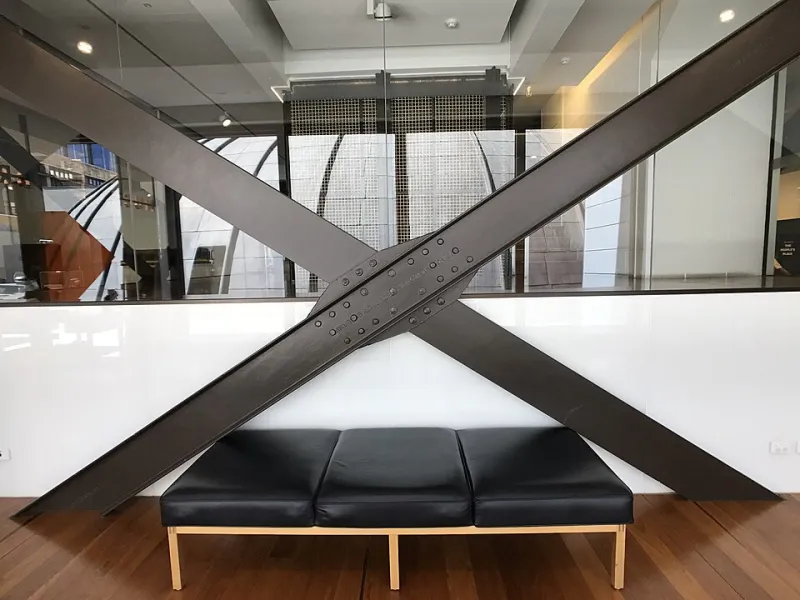
Photo: Kgbo, CC BY-SA 4.0, via Wikimedia Commons
Steel frames are admired for their precision, their slenderness and their ability to keep a building's structure legible. They are less admired for their acoustics. A bolted beam or a composite mezzanine deck is an efficient conductor of structure-borne vibration, and a luminaire is an efficient radiator of it. The result is familiar to anyone who has lived with exposed steel: a pendant that rings faintly when someone crosses the landing, a linear fitting that buzzes when the hot water cylinder refills, or a downlight that flickers as a washing machine reaches its spin cycle.
Vibration is not usually a structural problem. It is a specification problem. Treating it as one — with isolation mounts, flexible connections and fixings chosen for the dynamics of the assembly rather than for convenience — is the difference between steel that performs quietly and steel that announces every footfall.
Sources and symptoms
Vibration enters a steel frame from several directions. Footfall on mezzanine decks and stair flights is the most obvious; plumbing, MVHR units, pumps, washing machines and external doors are equally capable. Road traffic and rail can contribute a low-frequency background. Steel's low inherent damping means these inputs travel further than they would in a timber frame or a masonry wall, and bolted connections can loosen over time, changing the path.
At the luminaire, the symptoms tend to fall into three groups. Rattles come from loose diffusers, trims, glass panels or lamp holders. Hum comes from drivers, transformers and dimmer interactions, and is often amplified when a fitting is rigidly coupled to a resonant panel. Flicker is more serious: it can indicate intermittent contact at a terminal, lamp holder or connector, and vibration is a common trigger. Each symptom has a different remedy, and isolation alone will not cure a poorly made fitting.
The isolation principle, scaled for light fittings
Every isolation mount is a spring. Its job is to place the natural frequency of the mounted assembly well below the frequencies that excite it. Footfall on a domestic floor typically excites in the 5–20 Hz range; plant and pumps often sit higher, around 25–50 Hz. As a rule of thumb, the system natural frequency should be no more than one-third of the lowest forcing frequency. For a light fitting, that usually means a softer mount than a generic rubber washer provides — but not so soft that the fitting becomes unstable or sags visibly.
Elastomer choice matters as much as stiffness. EPDM and silicone cope better with heat and ageing than natural rubber; neoprene is common but can harden. Compression set, temperature range and fire performance should all be declared. A washer that is over-compressed during installation loses much of its isolation. The fixing detail should include a controlled compression stop or a specified torque, not an instruction to tighten until the fitting feels solid.
Fixings that do not fight the beam
Anti-resonance fixings are not exotic. Nylon-insert lock nuts, threadlocking compound and damped brackets all help, provided they are part of a considered detail. The common failure is a rigid bridge: a metal conduit, armoured cable gland or steel bracket that bypasses the isolation washer and reconnects the luminaire to the beam. Flexible connections — a service loop, a short length of flexible conduit, a strain-relieved cable — are needed to preserve the isolation path.
Earthing needs explicit attention. Under BS 7671, the protective earth path must remain continuous. Many isolation washers are non-metallic, so a separate bonding conductor may be required. Double-insulated fittings avoid the problem but are not always appropriate. In escape routes and other fire-sensitive locations, isolation components must not compromise the fire performance of the supporting structure; a metal load path or a tested assembly may be needed.
A specification sequence
Begin with the sources. Identify the steel-framed zones where footfall, plumbing or plant vibration is likely, and note the mounting method: direct to beam, to a Unistrut channel, to a suspended ceiling, or to a mezzanine soffit. Then set a performance requirement in the luminaire schedule. Ask for the isolator's natural frequency, static deflection and maximum transmitted force; ask for the elastomer type and its temperature and fire classification. Require a detail that maintains earth continuity. On site, build a mock-up and walk it. A hand test on the beam, a soft-mallet tap test on the fixing, and a listening check at night will reveal more than a datasheet. After four weeks, re-check torque and inspect for compression set.
Acoustic checks and long-term reliability
Acoustic performance is usually judged subjectively, but it can be measured. A sound level meter can confirm whether a rattle exceeds the background in a quiet room; NR25 is a reasonable target for bedrooms, though the relevant standard for the project may differ. Test dimmed states at 10%, 50% and 100%, because driver hum often appears only at low loads. Run the bath tap and the washing machine while listening. For long-term reliability, the risks are creep, corrosion and loosening. Elastomers age; fixings relax. A maintenance note in the O&M file should require inspection at the first service and re-torque where specified.
When isolation is not the answer
If a diffuser rattles, secure the diffuser. If a terminal flickers, remake the terminal. Isolation can mask a fault, but it will not repair one. Nor should isolation be allowed to introduce movement that a pendant cannot tolerate; secondary retention is sensible for heavy fittings. For long linear runs, wire-rope isolators or spring hangers may be more appropriate than pads. The aim is a quiet assembly, not a floating one.
Steel is an honest material: it transmits what it receives. Specifying for vibration is a small addition to the lighting package, but it is the one that decides whether an exposed frame reads as calm architecture or as an instrument. In 2026, with more steel-framed homes and light-commercial fit-outs exposing their structure, the quiet detail is worth designing.